
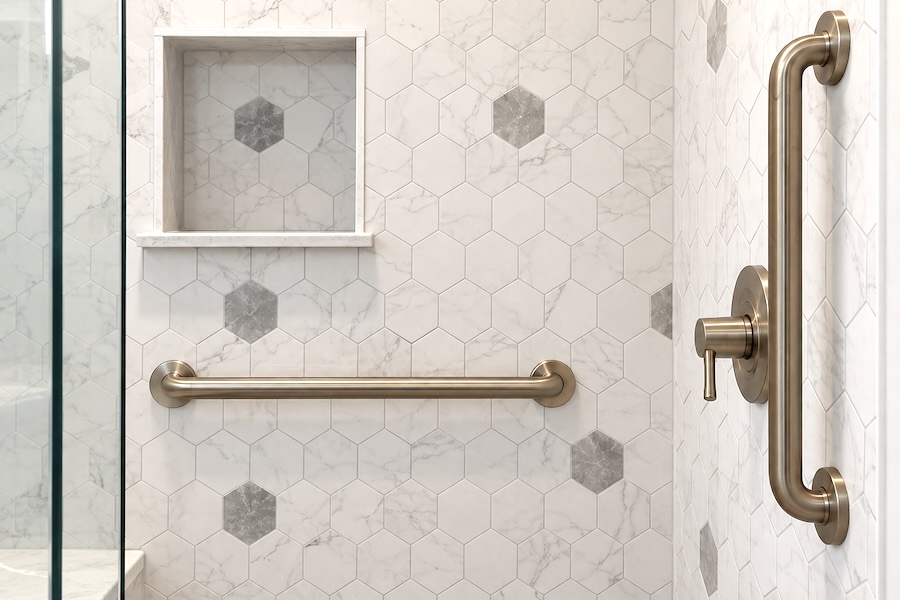
A grab bar is a fixed handhold anchored to the wall framing. It is built to hold a person’s full weight while they sit, stand or step in and out of a tub or shower.
Quick answer: Install grab bars where you change position: at the shower or tub entry, along the back and side walls of the tub or shower, and beside the toilet. Mount horizontal bars 33″ to 36″ above the floor, and anchor every bar into studs or solid blocking. Towel bars and suction-cup bars are not substitutes.
Why Grab Bars Matter
In a CDC study of bathroom injuries treated in emergency departments, about 81% were caused by falls. Roughly two-thirds happened in or around the tub or shower, and injuries on or near the toilet rose sharply with age. The CDC report noted that while 63% of homes used tub mats or nonslip strips, only 19% had grab bars, and it recommended bars inside and outside the tub or shower and next to the toilet.
Grab bars help anyone who has slipped on a wet floor, not only older adults. They are one of the least expensive safety upgrades in a bathroom remodel.
Where to Place Grab Bars
Put a bar anywhere someone shifts their weight. The heights below follow the ADA, the most widely used benchmark, and work for most adults. In a home, you can adjust them to the people who will use the bathroom.
At the Shower Entry
A vertical bar on the wall just inside the entry gives a handhold for stepping in and out. Set it so the bottom is around 36″ and the top around 60″ above the floor, covering both seated and standing grip heights.
Inside the Shower
- Back wall: A horizontal bar 33″ to 36″ above the floor, running most of the wall’s length.
- Control wall: A horizontal or vertical bar near the valve, so you can hold on while adjusting the water.
- Opposite a bench: In a shower with a seat, a horizontal bar on the wall facing the seat helps with standing up.
A curbless entry pairs well with grab bars. See our curbless shower guide.
At the Bathtub
- Entry: A vertical bar on the faucet-end wall at the tub edge for stepping over the rim.
- Back wall: Two horizontal bars, one 33″ to 36″ above the floor and a lower one about 8″ to 10″ above the tub rim for pushing up from a seated position.
- Control and head ends: Shorter horizontal bars on the end walls.
If stepping over a tub is the problem, a tub-to-shower conversion or walk-in tub may solve it.
Beside the Toilet
The ADA calls for a side-wall bar at least 42″ long, starting no more than 12″ from the back wall, and a 36″ bar on the wall behind the toilet, both 33″ to 36″ above the floor. In homes where the toilet sits between a vanity and a tub, a fold-down bar on the open side or a vertical bar on the nearest wall can work instead.
Types of Grab Bars
Straight Bars
The most common type, sold in lengths from about 12″ to 48″. Use them horizontally along walls or vertically at entries.
Angled and L-Shaped Bars
These combine a horizontal and vertical grip in one piece, so one bar supports both pushing up and steadying. They work well at a tub’s faucet end or beside a toilet.
Fold-Down (Swing-Up) Bars
Mounted on the wall behind or beside a toilet, they flip down when needed and up out of the way. They suit toilets without an adjacent side wall.
Dual-Purpose Bars
Some grab bars double as towel bars, toilet paper holders or shower shelves while still carrying the full rating. They blend into the room better than clinical-looking bars.
What to Avoid
Suction-cup bars can release without warning and are not rated to hold body weight. Standard towel bars are not designed to bear a person’s weight either.
Choosing Size, Grip and Finish
- Diameter: 1 1/4″ to 1 1/2″ fits most hands.
- Wall clearance: 1 1/2″ between the bar and the wall leaves room for fingers without letting an arm slip through.
- Grip texture: Knurled or textured bars hold better with wet, soapy hands.
- Finish: Stainless steel is the most durable. Brushed nickel, matte black and brass bars match the rest of the bathroom hardware.
- Rating: Look for bars and mounting hardware rated for at least 250 pounds.
How Grab Bars Should Be Installed
A grab bar is only as strong as what holds it. The ADA requires bars, fasteners and the wall structure behind them to withstand 250 pounds applied at any point.
Anchor Into Studs or Blocking
Studs are usually 16″ apart, which rarely lines up with where a bar should go. During a remodel, with the walls open, add horizontal wood blocking or a sheet of plywood between studs everywhere a bar might be needed: around the shower, along the tub and beside the toilet. Then a bar can be mounted anywhere in that zone, now or years later.
When There Is No Stud or Blocking
On finished walls, heavy-duty hollow-wall anchors made for grab bars can be used. Follow the manufacturer’s rating for the wall type. Standard plastic drywall anchors should never be used.
Drilling Through Tile
Tile needs a diamond or carbide bit to avoid cracking, and every hole must be sealed so water can’t get behind the tile. In a waterproofed shower, holes go through the membrane, so the fasteners need sealant or the gaskets supplied by the manufacturer.
Plan Blocking Even If You Don’t Need Bars Yet
Blocking costs very little during a remodel and avoids opening finished tile later. It is worth adding during any shower remodel if you plan to stay in the home.
ADA Grab Bars vs. Grab Bars at Home
The ADA Standards apply to public and commercial buildings. Private homes are not required to follow them, and no national code requires grab bars in an existing home. That gives homeowners flexibility.
What to Borrow From the ADA
- The 33″ to 36″ mounting height for horizontal bars
- 1 1/4″ to 1 1/2″ diameter with 1 1/2″ of wall clearance
- The 250-pound strength requirement
- Bars on the back and side walls of the toilet, tub and shower
Where Homes Can Differ
- Height: Set bars to the person using them. A shorter user may want them lower; a tall user may want a vertical bar that reaches higher.
- Position: A vertical entry bar is not in the ADA’s toilet layout but is one of the most useful bars in a home bathroom.
- Style: Decorative bars and dual-purpose accessories are fine as long as they carry the load rating.
An occupational therapist can recommend exact placement for someone recovering from surgery or managing a specific condition. Our accessible bathroom remodeling team can work from those recommendations.
How Much Do Grab Bars Cost?
These are typical ranges, not quotes:
- The bar itself: about $25 to $200, depending on length, material and finish
- Professional installation on an existing wall: about $150 to $400 per bar, more for tile or when an anchor system is needed
- Blocking during a remodel: usually a small add-on, since the walls are already open
The least expensive time to plan for grab bars is before the tile goes up.
Plan Safer Bathrooms With Metropolitan Bath & Tile
We design grab bars, blocking, benches, curbless entries and slip-resistant floors as part of one plan. For comfortable sink heights, see our bathroom vanity height guide. Visit one of our bathroom showrooms in Annandale, Manassas, Rockville or Bowie, or request a free estimate to start your accessible bathroom remodel.
Frequently Asked Questions
How High Should Grab Bars Be Mounted?
Horizontal bars are typically mounted 33″ to 36″ above the floor, measured to the top of the bar. Vertical entry bars usually run from about 36″ to 60″. In a home, adjust to the people using the bathroom.
How Many Grab Bars Does a Bathroom Need?
At minimum, one at the shower or tub entry, one inside along the back wall and one beside the toilet. Add more at the controls, opposite a shower bench and on a lower part of the tub wall as needs change.
Can Grab Bars Be Installed Without Studs?
Yes, with heavy-duty hollow-wall anchors rated for grab bars. Studs or blocking are still the strongest option. Never use plastic drywall anchors.
Should Grab Bars Be Horizontal, Vertical or Angled?
Horizontal bars help with pushing up and lowering down. Vertical bars help with pulling and steadying while stepping in or out. Angled bars do some of both. Most bathrooms benefit from a mix.
Do Grab Bars Have to Look Institutional?
No. Bars come in finishes that match faucets and towel hardware, and some double as towel bars, shelves or toilet paper holders.
Can I Add Grab Bars to a Fiberglass or Acrylic Tub Surround?
Only with anchors made for that material and solid backing behind it. Many one-piece surrounds can’t safely support a bar without opening the wall, which is a good reason to plan blocking during a remodel.