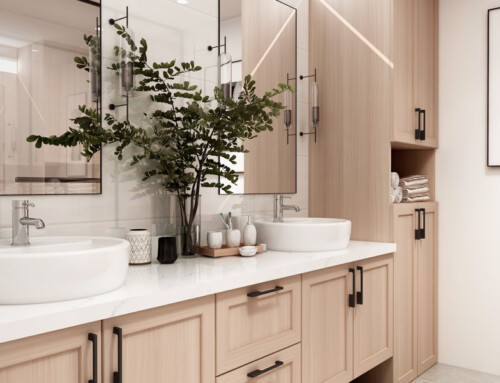
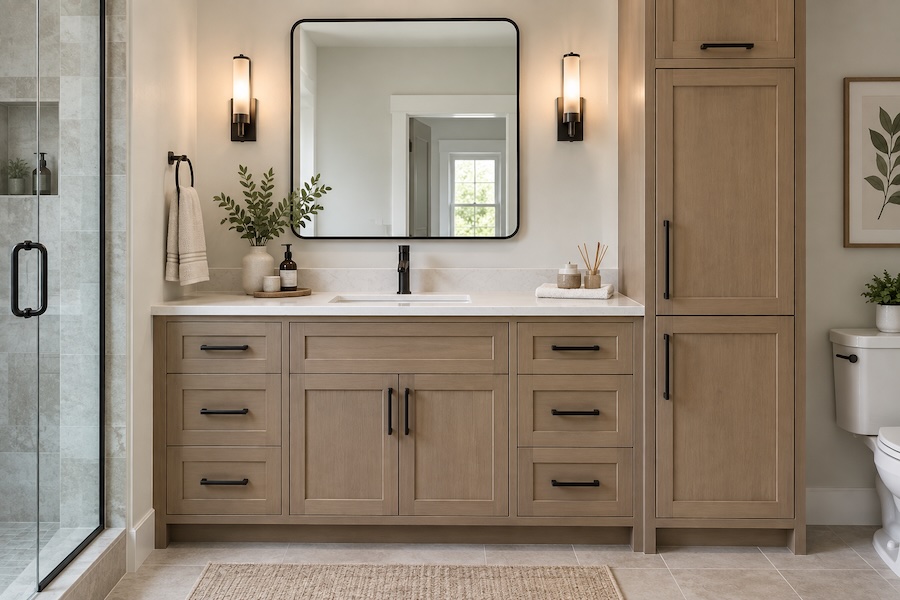
A double bathroom vanity works best in rooms 72″ wide or more, where two sinks won’t crowd out counter and drawer space. In anything under 60″, a single-sink vanity with matching storage usually functions better day to day.
The right choice comes down to room width, how many people share the space, and whether you use the sink at the same time each morning.
As a seasoned bathroom remodeler, one of the questions I hear most often is some version of: “Should we keep two sinks, or switch to a single vanity and get more storage and counter space back?”
After installing vanities in thousands of Maryland, Northern Virginia, and DC-area bathrooms, my answer is always the same: it depends on your room’s width, your household, and your morning routine — not on what’s trendy. Here’s how I walk clients through the decision.
How Much Room Width Do You Actually Need for a Double Vanity?
Room width is the single biggest factor, and it’s the one homeowners most often underestimate.
- 48″ wide: Two sinks will physically fit, but the plumbing lines under each bowl eliminate room for drawers, and counter space is nearly gone. This width is rarely recommended.
- 60″ wide: You get about 12″ of usable counter space and one small 12″ drawer stack between the sinks. Works for couples who prioritize two sinks over storage.
- 72″ or more: You get two full sinks, real counter space, and a functional set of drawers or cabinets between them. This is the width we recommend for most double-vanity installs.
Below 60″, the “storage tax” of a second sink is steep — you’re trading nearly all of your under-counter drawers and most of your counter surface just to have two basins.
If your bathroom footprint can’t comfortably fit 72″ of vanity, a single-sink layout will almost always feel more functional day to day.
Double Sink vs. Single Sink: Pros and Cons
Double vanity pros:
- Two people can wash up, brush teeth, or get ready at the same time without waiting
- Each person can keep their own products and space separate
- Buyers in family-oriented markets often expect double sinks in a primary bath
Double vanity cons:
- Requires significantly more width to avoid sacrificing storage
- Doubled plumbing (two supply lines, two drain assemblies, sometimes a second shutoff) adds material and labor cost
- Less counter space per person than a single-sink layout of the same width
- More surfaces to keep clean if one person is messier than the other
Single vanity with extra storage pros:
- One wide sink area with a full-width mirror often feels more spacious than two smaller sinks
- Drawers on both sides of a center sink give more actual storage than most double-sink layouts
- Lower plumbing cost since there’s one set of supply and drain lines instead of two
- Easier to keep tidy since there’s one basin instead of two
Single vanity cons:
- One person waits for the other during peak morning routines
- Some buyers in family markets specifically look for double sinks
What Does a Second Sink Add to the Plumbing Cost?
A second sink isn’t just a second bowl — it’s a second full supply-and-drain assembly. Each basin needs its own hot and cold supply lines, P-trap, and drain connection.
Budget for roughly double the rough-in labor and materials compared to a single-sink vanity of the same width. Wider vanities sometimes also require moving existing plumbing stub-outs, which adds further cost.
We factor this into every bathroom vanity installation quote so there are no surprises once the wall is opened up.
Does a Double Vanity Actually Increase Resale Value?
If you have the width to support 72″ or more without sacrificing storage, a double vanity is generally a safe resale bet. It’s an amenity many buyers expect in a primary bathroom, particularly in family-oriented neighborhoods.
But a cramped double vanity that leaves no counter or drawer space can read as a compromise rather than an upgrade. In that scenario, a well-designed single vanity with generous storage and a wide mirror often shows better than a squeezed-in double sink.
Appraisers and agents we work with consistently tell us buyers respond to a bathroom that feels well laid out over one that technically has two basins.
Consider Your Household’s Actual Habits
Space and resale value aside, the most practical question is simply: how do you and the people you share this bathroom with actually use it?
If you’re living alone, a single vanity with extra storage is almost always the better fit — you don’t need a second basin you’ll rarely use.
If you’re sharing with a partner, start by asking whether you’re really both at the sink at the same time. In most households we work with, morning routines are staggered — one person is showering while the other brushes their teeth, or one is doing hair while the other is getting dressed. A single wide sink with a full mirror often accommodates two people just fine. It’s worth thinking through your shared space more broadly — see our guide to designing a bathroom for two for more on that.
Cleanliness and product volume matter too. If one person tends to leave toothpaste or stubble in the sink, or if you each have a lot of products that need dedicated space, that’s a point in favor of either two sinks or a single sink with more drawer storage to keep things separated and put away.
Our Recommendation
In most bathrooms under 72″ wide, we steer clients toward a single, wider sink centered under a full-width mirror, with drawer banks on either side. This layout typically delivers more usable counter space and significantly more storage than a cramped double-sink setup, while still giving two people enough room to stand side by side at the mirror.
If your space is 72″ or wider, a true double vanity remains an excellent choice and one we install regularly across our Maryland, Northern Virginia, and DC-area projects.
There’s no universally “right” answer here — only the layout that matches your room’s dimensions and your household’s real routine. If you’re weighing this decision for your own remodel, our bathroom design team can measure your space and lay out both options side by side before you commit.
Frequently Asked Questions
Is a double vanity worth it in a small bathroom?
Usually not below 60″ of width — you’ll sacrifice nearly all counter and drawer space just to fit the second sink. A single vanity with storage typically works better in tight spaces.
How much extra does a double sink vanity cost to plumb?
Expect roughly double the rough-in plumbing cost compared to a single sink, since each basin needs its own supply lines and drain assembly.
Do double vanities always add resale value?
Only when there’s enough width to keep adequate counter and storage space alongside the two sinks. A cramped double vanity can be less appealing to buyers than a well-designed single vanity.
What’s the minimum width for a functional double vanity?
We recommend at least 72″ for a double vanity that includes real counter space and usable drawers between the sinks.